Bed for a Senior Dog Who Struggles to Get Up
| Feature | Why it matters | What to check |
|---|---|---|
| Supportive base | A thin or soft bed lets a heavier dog sink to the floor | Foam depth, and whether your hand reaches the floor when you press in |
| Low or open edge | A tall rim is one more thing to step over | The height of the sides where your dog gets on and off |
| Grip underneath | A bed that slides gives no purchase when pushing up | Whether the bed stays put on your floor, or needs a rug under it |
| Size | A bed that is too small leaves legs off the edge | Stretched-out length plus about 15cm |
| Cover | Accidents and mud are more likely with older dogs | A removable, washable cover |
Why might an older dog find it hard to get up?
There are many possible reasons: sore or stiff joints, weaker muscles, slippery floors, or a bed that sinks too far or is hard to step onto. Only a vet can tell you which applies, so if getting up has become newly difficult, or your dog yelps, limps or hesitates, book a check rather than just changing the bed. Our guide why is my dog stiff after sleeping explains what to mention to your vet.
What should I look for in a bed?
The table above sums up the features. In practice three things matter most: a base that holds your dog up off the floor, a surface that stays where you put it, and an edge your dog can step over without climbing. Everything else, such as colour or pattern, is secondary.
The bed cannot fix whatever is making getting up hard. What it can do is remove avoidable obstacles, so your dog is not fighting a sagging cushion or a sliding mat on top of everything else.
How deep should the foam be?
There is no official thickness, but a thin layer lets a heavier dog sink through to the floor, which is what an orthopaedic bed is meant to avoid. A simple home test is to press your whole hand into the foam where your dog's hip or elbow would rest and see if you can feel the floor.
Our Classic Orthopaedic Memory-Foam Bed has a 9cm memory-foam base, and it is a base, not a topper. Our guide memory foam density explained covers thickness and density, and the downsides of memory foam too.
Flat bed, bolster or round bed?
A flat or low-sided bed is usually easier to step onto and off than one with a tall rim, because your dog does not have to lift their legs over it. A raised rim suits dogs who like to curl up and rest their head on something, but for a stiff dog it can be one more barrier. Our guide calming bed vs normal bed compares the two.
The Classic bed is a rectangular memory-foam bed, and its page does not describe raised sides or a bolster.
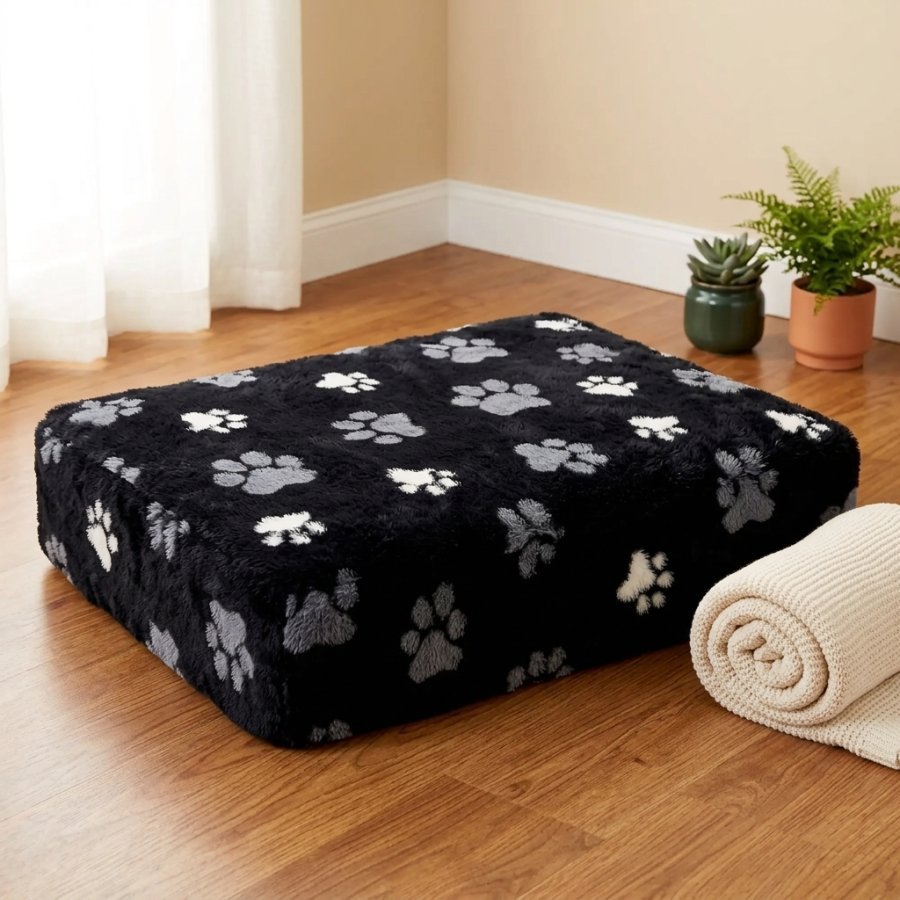 Classic Orthopaedic Memory-Foam Bed
A 9cm memory-foam base to keep hips and elbows off the floor. View
Where should I put the bed?
- On a floor with grip, or on a rug with a non-slip underlay, so paws do not slide as your dog pushes up
- Away from the top of the stairs and out of draughts
- Close enough to the family that your dog does not have to cross a slippery room to reach you
- With clear space on at least one side, so your dog can choose which way to get up
See non-slip flooring for dogs for more on rugs and runners.
What else makes getting up easier?
Trimmed nails and tidy fur around the pads usually improve grip, and a groomer or vet nurse can show you how. Keeping the route from bed to door clear and non-slip helps too, as does leaving a light on at night so your dog can see where they are going. Make changes one at a time, so you can tell which one is helping. Our guide helping an older dog stand up has practical ideas, and a support harness may help some dogs: ask your vet before trying one.
When is our bed not the right fit?
- Your dog measures more than about 90cm from nose to tail base, because the largest size is 105x75cm
- Your dog needs or loves a high rim or bolster to lean on
- Your dog leaks urine: the page does not describe the bed as waterproof, so see waterproof vs standard dog beds or washable or disposable dog pads
If none of those apply, the bed comes in Small (60x45cm), Medium (75x55cm), Large (90x65cm) and XL (105x75cm); our size chart shows how to choose.
Before you buy
Check the dimensions against your dog's stretched-out length plus about 15cm, and if your dog is between sizes, choose the larger. The cover is removable and machine washable, and the page asks you to check the care label. We dispatch from a UK warehouse and offer 30-day refunds: see returns. No bed solves a medical problem, so if getting up is hard, ask your vet.
Shop the Classic Orthopaedic Memory-Foam Bed
A 9cm memory-foam base to keep hips and elbows off the floor.
View the product — £59.99Last reviewed on 9 November 2026. General information, not veterinary advice.
Related guides
Best Dog Bed for Arthritis in the UK: Buying Guide
How to choose a dog bed for arthritis in the UK: foam depth, size, bolster or flat, cleaning, common mistakes and when a bed is not the answer.
Helping an Older Dog Stand Up: Practical Tips for Owners
Practical, gentle ways to make standing up easier for an older dog: grip, bedding and support, and when to ask your vet.
Why Is My Dog Stiff After Sleeping? When to Ask a Vet
Some dogs are slow to get going after rest. What owners often notice, what to tell your vet, and simple comforts at home. Not a diagnosis.
Non-Slip Flooring for Dogs: Laminate, Tile and Wood
Ways to make laminate, tile and wood floors safer for an older dog: runners, mats, tape and where to start. Ask your vet if slipping is new.