Dog Ramp Length and Angle: Getting the Fit Right
| Boot height | 155cm ramp | 185cm ramp |
|---|---|---|
| 45cm | 16.9 degrees | 14.1 degrees |
| 50cm | 18.8 degrees | 15.7 degrees |
| 55cm | 20.8 degrees | 17.3 degrees |
| 60cm | 22.8 degrees | 18.9 degrees |
| 65cm | 24.8 degrees | 20.6 degrees |
| 75cm | 28.9 degrees | 23.9 degrees |
What length of dog ramp do I need?
The right length depends almost entirely on one number: the height from the ground to the place your dog needs to reach, usually your boot lip or back seat. The taller that height, the longer the ramp needs to be to keep the slope gentle. As a rough guide, a ramp that is at least three times as long as the height it has to cover is a sensible starting point, and a longer one is gentler still.
Two quick examples. If your boot lip is 45cm off the ground, a 155cm ramp makes a slope of about 17 degrees. If your boot lip is 65cm off the ground, that same 155cm ramp climbs at about 25 degrees, while a 185cm ramp brings it down to about 21 degrees. Same dog, same car type, a noticeably different climb.
This guide shows you how to measure, how to do the simple maths yourself, what to expect from different ramp lengths, and what else matters beyond length. We are a pet-product store, not vets, so we can't tell you which angle is right for your dog's joints. If your dog has a mobility condition or is recovering from surgery, your vet or physiotherapist is the right person to say what is suitable.
Why does the angle matter so much?
A ramp turns a vertical jump into a slope. The steeper the slope, the more your dog has to push upward with each step and the more their hind legs and back have to work. A ramp that is too short for your car's height can end up quite steep, and a steep ramp can be harder than you'd expect for a dog with weak hind legs, sore joints or a long back.
There is also a practical side. Steep ramps are more intimidating to a nervous dog, and they tend to be avoided. A gentler slope is easier to climb, easier to descend and easier to trust, which is why measuring before you buy matters more than any other decision with a ramp.
There is no single official angle that suits every dog. Ramp sellers often quote figures somewhere in the region of 15 to 25 degrees as a comfortable range for ordinary use, but treat that as a rule of thumb rather than a veterinary standard. Smaller dogs, older dogs, dogs with long backs and dogs with mobility limits are usually better with the gentlest slope you can manage.
How do I measure my car's boot height?
You only need a tape measure and five minutes. For accuracy, do this with the car on level ground and loaded as you normally would, because a car with luggage sits lower than an empty one.
- Step 1. Park on flat, level ground. A sloping drive will give you the wrong number.
- Step 2. Open the boot fully. If your dog uses the back seat instead, open that door.
- Step 3. Measure straight down from the top of the boot lip, the point your dog's paws will step onto, to the ground. Hold the tape vertical, not leaning.
- Step 4. Write the number down in centimetres. Measure a second time to check.
- Step 5. Measure the space behind the car as well. A ramp needs room to extend, and you want to be able to stand beside it.
- Step 6. Check where the top end of the ramp will actually rest. Some boots have a bumper or lip that sits further out than you'd think.
If you drive more than one car, or sometimes borrow a vehicle, measure each one. A ramp that suits a hatchback may be too short for a friend's SUV.
How do I work out the angle for myself?
This is simple trigonometry, and a phone calculator can do it. The ramp, the ground and the height of your boot form a right-angled triangle, with the ramp as the long sloping side. So:
angle = asin(height / ramp length)
In plain English: divide your boot height by the ramp length, then press the "sin-1" or "asin" button on a calculator. Use the same units for both numbers, centimetres is easiest. You can also reverse it: height = ramp length x sin(angle).
Here are some rough values for two common ramp lengths, rounded to the nearest degree, so you can find your car without a calculator.
- Boot height 45cm: about 17 degrees with 155cm, about 14 degrees with 185cm.
- Boot height 50cm: about 19 degrees with 155cm, about 16 degrees with 185cm.
- Boot height 55cm: about 21 degrees with 155cm, about 17 degrees with 185cm.
- Boot height 60cm: about 23 degrees with 155cm, about 19 degrees with 185cm.
- Boot height 65cm: about 25 degrees with 155cm, about 21 degrees with 185cm.
- Boot height 70cm: about 27 degrees with 155cm, about 22 degrees with 185cm.
- Boot height 75cm: about 29 degrees with 155cm, about 24 degrees with 185cm.
The three-times rule is just a shortcut for the same thing. A ramp three times as long as the height gives about 19.5 degrees, four times gives about 14.5 degrees, and a ramp only twice as long as the height gives a steep 30 degrees.
Worked examples
Example 1: a low hatchback. The boot lip measures 45cm. The 155cm ramp gives asin(45 / 155) = asin(0.290), about 17 degrees. The 185cm ramp gives asin(45 / 185) = asin(0.243), about 14 degrees. Either length is comfortable, and the shorter one is lighter to handle and easier to store.
Example 2: a typical estate. The boot lip measures 60cm. The 155cm ramp gives asin(60 / 155) = asin(0.387), about 23 degrees. The 185cm ramp gives asin(60 / 185) = asin(0.324), about 19 degrees. Here the longer ramp is noticeably gentler, and worth the extra if your dog is older or stiff.
Example 3: a taller SUV. The boot lip measures 75cm. The 155cm ramp gives asin(75 / 155) = asin(0.484), about 29 degrees. The 185cm ramp gives asin(75 / 185) = asin(0.405), about 24 degrees. Even the longer ramp is a fairly steep climb here, so for a dog with significant hind-leg weakness you would want to ask whether a ramp is the right tool for this car at all, or whether a different vehicle height, a lift or help from a second person is needed.
Example 4: a bed or sofa. A surface 35cm high and a 155cm ramp gives asin(35 / 155), about 13 degrees, which is very gentle. A ramp that is long enough for a boot is usually more than long enough for furniture, which is useful if you want one ramp for home and the car.
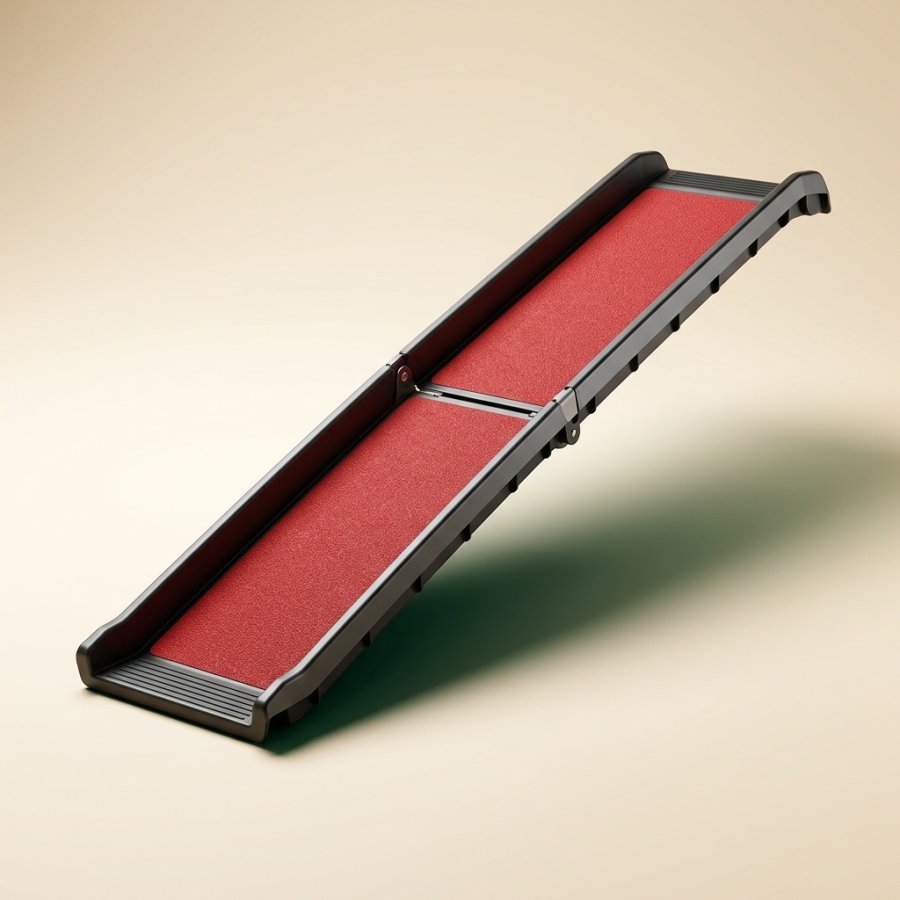 Foldable Non-Slip Dog Ramp
A folding ramp to help a dog get into the car. View
Is 155cm long enough for your car?
Using the maths above, you can decide for yourself. Our ramp is 155cm. If your boot lip is under about 50cm, that length is comfortable. Between about 50cm and 65cm, a longer ramp from another seller would be the gentler choice for an older or stiff dog, and we would rather say so than sell you something that does not fit. Above that, even a 185cm ramp climbs at over 20 degrees, so think hard about whether a ramp suits that car and your dog.
Always compare with your actual dog's weight and your boot space.
What else matters besides length?
Length is the big one, but a few other details decide whether the ramp is used every day.
- Surface grip. Look for a genuine textured, non-slip surface that grips in the wet, not a smooth painted one. Dogs with unsteady hind legs notice a slippery surface immediately.
- Side rails. Raised sides help a nervous dog stay on the ramp and not step off the edge.
- Width. The ramp should be clearly wider than your dog, with room to spare.
- Weight capacity. It should comfortably exceed your dog's weight, not just match it. Dogs who hesitate or shift their weight mid-ramp add load.
- Stability at the top. The ramp should rest securely on the lip and not wobble or twist. Test it before your dog does.
- Carrying weight. If you can't lift and fit it easily, it will stay in the garage. Check the folded size and weight honestly.
- Your own space. Measure how much room you have behind the car, and whether you can park somewhere level to use it.
Then there is training. A well-chosen ramp still has to be introduced slowly, starting flat on the floor with treats. We cover that step by step in helping a dog with hip dysplasia in and out of the car.
What are the common mistakes?
- Measuring the car without its normal load, so the ramp ends up steeper than planned.
- Measuring to the bottom of the bumper instead of the top of the boot lip.
- Choosing by price alone and ending up with a short ramp that is too steep.
- Using the ramp on a hill or a kerb, which changes the angle and the grip.
- Assuming a ramp is always the answer. For some cars and some dogs, lifting aids or a different approach is kinder.
- Skipping the vet. If your dog is recovering from surgery or has a diagnosed condition, ask your own vet or physiotherapist whether ramp use is appropriate yet and what limits to follow.
What if the angle is still too steep?
If your measurements give a steeper angle than you're comfortable with, you have options. Choose the longer ramp. Aim for a lower entry point, such as the back seat instead of the boot, if your car has one that suits your dog. Ask whether a helper can steady your dog from behind on the way up. For smaller dogs, a careful lift may be the better choice.
For dogs with serious hind-leg weakness who can't manage any slope, speak to your vet about what would help. The ramps range shows everything we stock.
Quick answers
How long should a dog ramp be for a car? A common rule of thumb is at least three times the height from the ground to the boot lip, and longer is gentler. Work out your own angle using asin(height / length).
Is 155cm long enough for an SUV? It depends on the exact height. With a 75cm boot lip, a 155cm ramp climbs at about 29 degrees, which is steep.
What angle is safest? There is no official figure that suits every dog. Gentler is generally easier, and any dog with a diagnosed condition should follow their vet's advice.
Can I use one ramp for the car and the sofa? Often yes, since a ramp that is long enough for a boot is more than long enough for most sofas. The only issue is space indoors.
Do I need to measure my dog too? For a ramp, the key numbers are the weight and the width of the dog. Our guide to measuring your dog for the right product size covers the rest.
Try our free dog ramp angle calculator to work out the slope for your car or sofa.
Shop the Foldable Non-Slip Dog Ramp
A folding ramp to help a dog get into the car.
View the product — £59.99Last reviewed on 10 October 2026. General information, not veterinary advice.
Related guides
How to Measure Your Car for a Dog Ramp (With Angle Chart)
Measure your boot height, check it against 120cm, 155cm and 185cm ramps, and see the slope for each before you buy.
Dog Ramp or Steps for the Car? How to Choose
Ramp or steps for getting a dog into the car? How each works, which heights suit which, and what to measure before you buy.
Best Dog Ramp for a Car in the UK: What to Check First
Looking for the best dog ramp for a car in the UK? A buyer checklist: boot height, length, weight rating, width, grip and folded size.
Dog Ramp Weight Limit and Width: How to Choose
Dog ramp weight limit and width explained: how much margin to leave, how to measure your dog and what the 90kg rating on our ramp means.