8 Signs Your Dog Needs Steps or a Ramp (And Which to Choose)
How do I know if my dog needs steps or a ramp?
You can usually tell by watching how your dog handles the everyday jumps: onto the sofa, into the car, off the bed, up and down stairs. Dogs are very good at hiding discomfort, so the early signs are subtle and easy to put down to fussiness, laziness or a bad mood. A pause before a jump, a different approach to the same sofa, a stiff first few steps after a nap: these are the changes to look for.
If you spot one or more of the signs below, a ramp or steps can take the jumping out of your dog's day, which is a sensible, low-risk change whatever is behind it. It does not tell you what is going on. We're a pet-product store, not vets, so we can't diagnose anything, and anything that looks like pain deserves a conversation with your own vet.
A word on honesty up front: we sell a ramp but not steps, so where we discuss steps we're explaining how to choose well, not selling you one.
Signs 1 to 3: changes around jumping on and off furniture
Sign 1: hesitating before jumping onto furniture. A pause before the jump, rather than a refusal, is often the earliest sign. Your dog looks at the sofa, then at you, then jumps. It is easy to mistake for a dog who just wants a bit of attention, but if it is new, it counts.
Sign 2: a smaller jump, or a run-up they didn't need before. Watch for dogs angling their jump differently, using a chair or a cushion as a stepping stone, or taking a run-up onto a bed or sofa they used to clear in one motion. Front paws on the edge and then a scramble with the back legs is another common sign.
Sign 3: yelping or stiffness immediately after jumping down. Landing puts far more sudden force through the joints than jumping up. If your dog yelps, or walks stiffly straight after landing, that is worth mentioning to your vet rather than waiting to see if it goes away. In the meantime, stop the jumping. A ramp or steps to the sofa or bed means they can get on and off without the landing.
Signs 4 and 5: the car and the stairs
Sign 4: avoiding the car. If your dog used to jump straight into the boot and now waits by the door, needs coaxing or will only go in when lifted, this is frequently one of the first visible changes. Dogs often love the destination and still dread the getting in. Our guide to helping a dog with hip dysplasia in and out of the car goes through the options in more detail.
Sign 5: reluctance on stairs, especially going down. Going down stairs loads the front legs and shoulders more than going up, so reluctance specifically on the way down is a common early pattern. Some dogs take stairs very slowly, put both front paws on a step at a time, "bunny hop", or stop at the top and refuse to descend. Because real stairs can't be replaced by a ramp, a support harness with a handle gives you a way to help. We cover how to choose one in choosing the right support harness.
Signs 6 to 8: getting up, licking and general slowing
Sign 6: slower to rise from lying down. A longer-than-usual pause and stiffness in the first few steps after getting up, which then eases as they warm up, is a pattern often seen in arthritic dogs. Many owners notice it first after a night's sleep or a long car journey.
Sign 7: licking or chewing at a specific joint. Persistent attention to one leg or joint is worth a vet check before assuming it is mobility-related. It might be skin, a paw problem, or something else entirely.
Sign 8: general slowing down you've put down to getting older. Some slowing is a normal part of ageing, but it is easy to accept a dog sleeping more, walking less and avoiding things as simply age when some of it may be discomfort that your vet could help with. If a dog has changed over a few weeks or months, mention it at the next check-up, even if nothing seems dramatic.
Is it ageing or something to ask the vet about?
Dogs of any age can show these signs, not only seniors, and some are simply normal. As a rule of thumb, book a vet appointment sooner rather than later if you notice any of the following.
- Sudden change. A dog who was fine yesterday and is limping, yelping or refusing to move today.
- Pain behaviour. Yelping, snapping when touched, trembling, panting at rest or crying out when picked up.
- Limping that lasts more than a day or so, or gets worse.
- Swelling, heat or a visible change at a joint.
- Reluctance to walk, or a dog who won't use their back legs normally.
- Changes in toileting, appetite or mood alongside the stiffness.
If the signs are mild and gradual, it still helps to take a short video on your phone of your dog getting up, walking and going up a step or two, and to jot down when you notice stiffness. A vet can't always see what your dog does at home, and a clear video helps. A ramp or steps do not replace a proper check, and they will not treat anything. They just reduce the demands on a dog's joints while you find out what is going on.
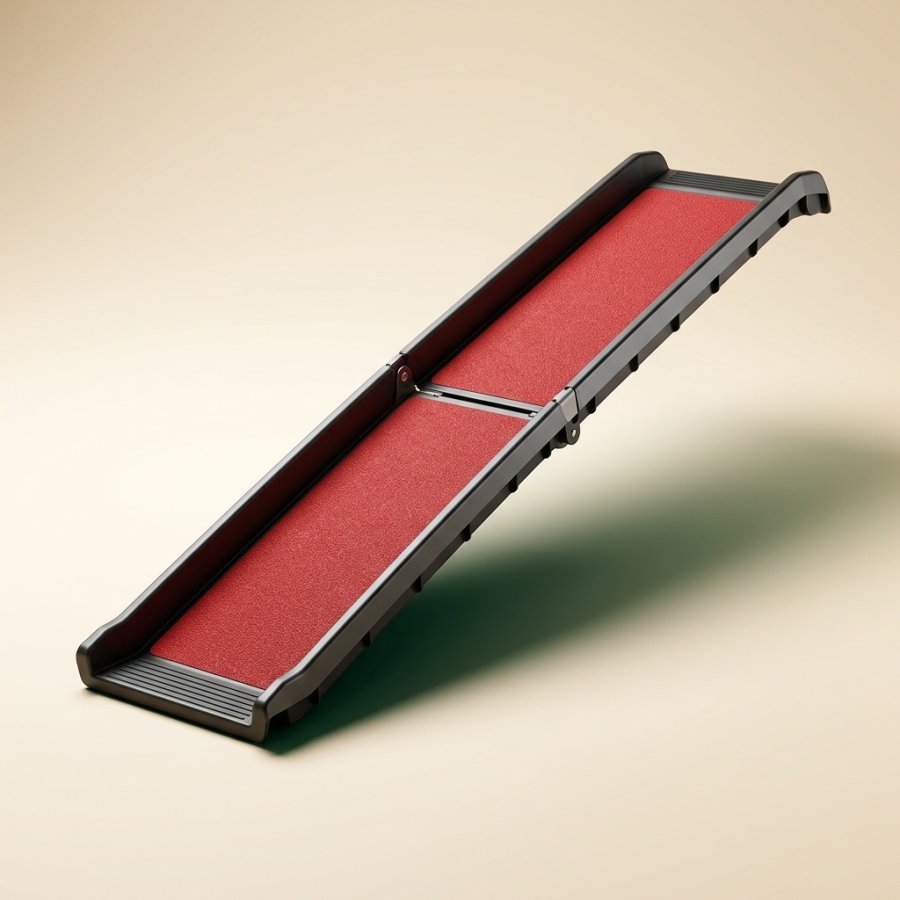 Foldable Non-Slip Dog Ramp
A folding ramp to help a dog get into the car. View
Steps or a ramp: which suits your dog?
Neither is better in every situation. Here is a straightforward comparison.
- Steps tend to work well where the height is modest and the dog can still bend their hips, knees and elbows comfortably but lacks the power for a full jump. They are compact, stable and a good fit beside a sofa or bed, and they suit small and medium dogs especially.
- A ramp tends to suit dogs for whom bending itself looks uncomfortable, or when your vet has mentioned hip, spinal or post-surgical precautions. It is also generally the better answer for a car boot, where the height to cover is often too much for steps.
- Neither is needed if your dog is moving easily and your vet has no concerns, or if the thing they struggle with is a floor (see below) rather than a height.
- Lifting is a possibility for small dogs on occasion, but a repeated lift of a heavy dog is hard on your back and may be uncomfortable for them.
- Raising the furniture's access point (or keeping a dog off the sofa and giving them a good bed at floor level) is a legitimate answer too. For some dogs, the happiest solution is a really good orthopaedic bed on the floor beside you rather than a staircase to the sofa.
If you are still unsure, our two-minute quiz asks about your dog's size, the places they struggle and any vet advice, then points you towards sensible options.
How do I choose steps (we don't sell them)?
We don't sell pet steps, so we'd rather give you a good checklist than a sales pitch. When you are looking at steps, check these.
- Total height. Measure from the floor to the surface your dog wants to reach. The top step should sit no more than roughly 20cm below it, so the last stride stays easy on stiff joints.
- Step rise. Each individual step should be low enough for your dog's leg length. Three or four small steps are kinder than two big ones.
- Tread depth and width. The tread should be deep enough for all four paws to fit on a step at once if your dog tends to stop, and wide enough that they don't step off the side.
- Stability. They shouldn't rock or slide when your dog puts weight on them, and they should be sturdy enough for your dog's weight.
- Weight rating. Always above the dog's weight with room to spare.
- Placement. Put them against the furniture on the side your dog naturally approaches, with a clear run in front of them.
Remember that any set of steps still asks your dog to lift each leg up a step, so for a dog recovering from surgery or one who struggles to bend, check with your vet that steps are suitable before choosing them over a gentler slope.
Where does a ramp fit in?
For car boots, high beds and the occasional high sofa, a ramp is often the more practical choice. The one ramp we sell is the Foldable Non-Slip Dog Ramp. It is a long, folding ramp, so it suits cars and high beds better than a sofa in a small room, where a good set of steps may be the tidier answer. Check the length against the height you need to cover using our ramp length and angle guide before buying.
Not every problem is a height problem. If your dog slips and scrabbles on laminate, tile or wood, grip is the issue rather than steps or a ramp. Our guide on why dogs slip on hard floors explains what helps, from rugs to socks. A few small changes around the house, such as rugs on slippery floors and a gate at the top of the stairs, can do more than one big purchase.
How do I get a dog started with steps or a ramp?
Whatever you choose, introduce it slowly. Place it in the room or at the car and let your dog sniff it, then reward them for stepping on, then for one step up, then the full route. Keep sessions short and positive, never push or lift a nervous dog onto it, and don't scold a refusal. Some dogs take a day, others a couple of weeks.
Make the new route the easiest one by removing the old one. If you leave a chair next to the sofa as a stepping stone, your dog may carry on using it.
Quick answers
How early should I introduce steps or a ramp? Earlier than you think. It is much easier to teach a dog who is still happy to jump, and starting before pain sets in means the habit is already there when you need it.
Can small dogs use a ramp? Yes, although a small dog may be better off with steps or a lift for sofas. Check the ramp's width, rails and the angle first.
Will steps or a ramp cure my dog's stiffness? No. They reduce how much your dog has to jump, which can be kinder on the joints, but they don't treat any condition. Your vet can advise on diagnosis and pain relief.
My dog refuses the ramp. What now? Go back to the beginning with the ramp flat on the floor and a lot of treats. If your dog is anxious or in pain, speak to your vet before pushing on.
Do I need both? Sometimes. Many households have steps for the bed or sofa and a ramp for the car.
Try our free dog ramp angle calculator to work out the slope for your car or sofa.
Shop the Foldable Non-Slip Dog Ramp
A folding ramp to help a dog get into the car.
View the product — £59.99Related guides
Dog Ramp or Steps for the Car? How to Choose
Ramp or steps for getting a dog into the car? How each works, which heights suit which, and what to measure before you buy.
Arthritis in Dogs: Early Signs, Causes and What Helps
Arthritis in dogs explained in plain English: early signs, common causes, how vets diagnose it and everyday changes that may help. Not veterinary advice.
Why Dogs Slip on Hard Floors (And When Grip Socks Help)
Why dogs slip on hard floors, and practical ways to improve grip at home, from rugs and runners to nail care.
Dog Ramp or Steps for the Sofa and Bed: How to Choose
Ramp or steps for the sofa or bed? How to measure furniture height, floor space and your dog's size, and when a floor bed is the simpler answer.