Memory Foam Density: What Makes a Bed Truly Orthopaedic
What does "orthopaedic" actually mean on a dog bed?
On a dog bed, "orthopaedic" is a marketing word, not a standard. There is no legal definition and no testing body that a bed must pass before it can use the label. The word usually signals that the bed is meant to support joints, but the bed underneath can be anything from a thick slab of dense foam to a thin sheet laid over polyester stuffing.
So the question to ask is not "is it orthopaedic?" but "what is it made of, and how much of it is there?" The answers come down to three things: the type of foam, its density, and its thickness. This guide explains each in plain English, offers a few simple tests, and is honest about where memory foam is not the right pick.
As a small shop rather than vets, we cannot say what bed your dog needs for a particular joint condition. If your dog is stiff or sore, your vet is the right person to ask. What we can do is help you judge whether a bed is built to last.
What are the main types of dog bed filling?
Most beds use one of a handful of materials, and each behaves differently under a dog's weight.
- Polyester fibre fill. Soft and cheap, like a cushion. It feels comfortable at first but compresses quickly and tends to go flat where your dog lies, leaving little support.
- Standard polyurethane foam. A basic foam block or chips. Quality varies a great deal. Cheap versions can lose their shape quickly.
- Egg-crate or convoluted foam. A foam sheet with a bumpy surface. It feels supportive when new, but is often only a few centimetres thick, and the bumps can flatten over time.
- Shredded foam. Pieces of foam in a bag. It moulds to the dog but can shift and clump, leaving thin spots.
- Memory foam. A dense, slow-recovery foam that moulds to the body's shape and then returns slowly. It is the material most often used for orthopaedic beds.
- Layered designs. Many beds combine layers, for example a firm base with a softer top. These can work very well when the base layer is thick enough.
None of these is automatically good or bad. A well-made, dense polyurethane foam can outperform a poor memory foam. What matters is quality and depth, not the name on the label.
What does foam density mean, and does it matter?
Density is how much foam is packed into a given volume, usually measured in kilograms per cubic metre (kg/m3). Denser foam generally has more material in it, which tends to mean it supports weight better and keeps its shape for longer. Low-density foam feels soft quickly, then flattens.
The catch is that density is rarely stated clearly on dog beds, and there is no shared scale that tells you what counts as "high". One brand's "high density" may be another brand's average. We would be wary of any seller who uses the phrase without giving a figure or any other detail, and equally of anyone who quotes an impressive number with nothing to back it up.
For transparency, our own listings describe our foam as high-density and give the depth, but they do not currently state a kg/m3 figure. If a figure matters to you, ask us before you buy rather than assuming.
A practical rule: use density as one clue, not the whole answer. Pair it with thickness, the weight of your dog and the simple tests below.
How thick should the foam be for your dog?
Thickness matters because a dog's weight compresses the foam. If the layer is too thin, it "bottoms out", and the dog's hips or elbows end up pressing through to the floor even though the bed looks plump.
There is no official table, but as a rough guide:
- Small, light dogs can often be comfortable on a thinner layer, although older small dogs with sore joints still benefit from decent depth.
- Medium and large dogs generally need a supportive layer of around 7cm or more.
- Heavy dogs need more depth and a firmer foam, because softer foam compresses fully under their weight.
When a listing gives a thickness, check what it refers to. A bed that is "10cm tall" might have a 3cm foam sheet and a lot of fluffy fibre. You are looking for the thickness of the supportive foam itself. Wording such as "foam base", with a stated depth, is more reliable than "extra thick" or "deep fill".
For reference, our Classic Memory-Foam Bed has a 9cm high-density memory foam base. It is a base, not a topper laid over standard filling. Prices run from £59.99 for Small to £89.99 for XL.
What should the rest of the bed look like?
Foam is the heart of the bed, but the details around it affect how long it lasts and how well your dog can use it.
- Cover. Removable and machine-washable, with a sturdy zip. A cover you cannot wash is a problem for an older dog's bed.
- Shape. Flat suits dogs who stretch out; a bolster suits those who lean. Pick the shape your dog uses.
- Size. Big enough to stretch fully. A dog hanging a hip over the edge loses most of the benefit.
If you are choosing a size, our guide to measuring your dog covers it step by step.
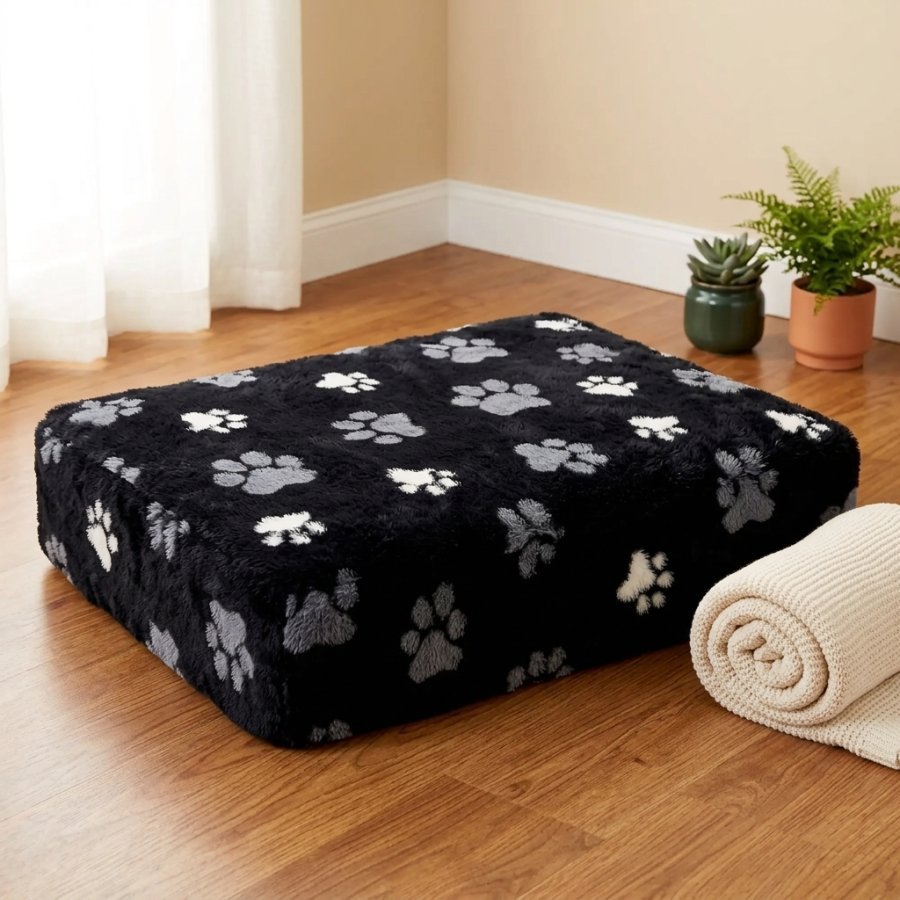 Classic Orthopaedic Memory-Foam Bed
A 9cm memory-foam base to keep hips and elbows off the floor. View
How can you test a bed at home?
These checks take a couple of minutes and need no equipment.
- The press test. Push your palm into the centre of the bed and hold for a few seconds, then lift. Memory foam is slow to recover by design, so it will not snap back instantly. It should return to shape within a short time and the dent should not remain. If it stays dented, or you can feel the floor through it, it is no longer giving real pressure relief.
- The sit test. Press down with your whole hand or a knee in the spot where your dog's hips would be. If you feel the floor, the layer is too thin for that dog.
- The edge check. Look at the sides and corners. Foam that has sagged, split or lost its edges is a sign of age.
- The smell test. A strong chemical smell on a new bed usually fades with airing. A damp or stale smell on an older bed suggests liquid has reached the foam.
- The dog test. Watch how your dog gets on. If they avoid the bed or keep choosing the floor beside it, the bed may not suit them, whatever the specification says.
Do the press test every few months. Foam can lose its support before it looks tired.
What are the downsides of memory foam?
It is a good material, but not a perfect one, and some dogs do better on something else.
- It can feel warm. Memory foam responds to body heat and can hold warmth. Dogs that run hot may prefer a cooler cover or a different foam. Our guide to cooling mats covers that side.
- It recovers slowly. Some dogs, especially frail ones, find a very soft memory foam harder to push up from. A firmer foam can be easier.
- Firmness varies with temperature. In a cold room, memory foam can feel firmer than expected.
- It is heavier than fibre beds, which matters if you move the bed around.
- Good foam costs more. A genuinely thick, dense base is more expensive than a fibre-filled cushion, and a cheap version of memory foam is not necessarily better than a cheap version of anything else.
If your dog runs hot or struggles to rise, introduce the bed gradually and mention any change in how they get up to your vet.
Is a more expensive bed always better?
No. A high price does not guarantee a thick foam base, and a modest price does not rule one out. Compare what each seller tells you: depth of foam, type of foam, cover and liner details, size, and whether the underside grips. If a listing is vague on all of these, you cannot tell what you are paying for.
If your dog already has a bed that is thick, supportive and still holds its shape, you do not need to replace it. Our guide to choosing the best bed for arthritis puts these checks into a buying checklist, and you can see our range of orthopaedic dog beds or our Classic Memory-Foam Bed if you want to compare.
Quick answers
Is memory foam better than egg-crate foam? Usually for support, because it is typically thicker and denser, but a thick, firm foam of any kind can be better than a thin memory foam layer. Check thickness and quality, not just the name.
What density should I look for? There is no universal figure, and few sellers publish one. Ask for the number and the depth, and use the press test when the bed arrives.
How long does foam last? It depends on the foam, your dog's weight and how much they use it. Check it every few months and replace it when it no longer returns to shape.
Can I add a topper to a flat bed? It can help a little, but a thin topper over thin filling is rarely a fix. A proper foam base is a better starting point.
Does an orthopaedic bed treat arthritis? No. It can make resting more comfortable, but it does not treat a joint condition. Your vet is the right person for diagnosis and pain management.
Print our free one-page measuring sheet for beds, harnesses, ramps and bowls.
Shop the Classic Orthopaedic Memory-Foam Bed
A 9cm memory-foam base to keep hips and elbows off the floor.
View the product — £59.99Related guides
Best Dog Bed for Arthritis in the UK: Buying Guide
How to choose a dog bed for arthritis in the UK: foam depth, size, bolster or flat, cleaning, common mistakes and when a bed is not the answer.
Choosing a Dog Bed for Hip Dysplasia: What to Look For
What to look for in a bed for a dog with hip dysplasia: base depth, size, cover and placement, and why a bed is a comfort, not a treatment.
How to Measure Your Dog for the Right Product Size
How to measure your dog for a bed, ramp or feeding stand, with step-by-step instructions and what to do between sizes.
How to Wash a Memory Foam Dog Bed and Its Cover
How to wash a memory foam dog bed and its cover: machine wash the cover, spot clean the foam, dry it fully and keep smells in check.