Dog Ramp Weight Limit and Width: How to Choose
| Measure | How | Why it matters |
|---|---|---|
| Your dog's weight | Use scales; for a big dog ask your vet practice if you can use theirs | Compare it with the ramp's weight rating |
| Your dog's width | Across the shoulders and the hips while standing | The walkway should be clearly wider than this |
| Boot opening width | At the narrowest point | The ramp must sit inside the opening |
| Boot opening height | From the lip up to the tailgate or roof edge | Your dog's head needs room as they step in |
| Boot-lip height | Straight down to level ground, car loaded | Sets the slope: see the angle calculator |
What does a dog ramp weight limit actually mean?
A weight limit, or rating, is the maximum the maker states the ramp should carry. It is the manufacturer's figure rather than an independent test, and sellers may not all measure it the same way. So treat it as a ceiling to stay well below, not a target to reach.
Our ramp is rated for dogs up to 90kg. That figure is on the product page and we do not add anything to it.
Two more points. Assume a rating is for one dog at a time, so do not send two dogs up together. And a rating only holds for a ramp in good condition and set up properly, with the top end resting securely and the base on firm ground. Check the hinge, surface and sides now and then, and stop using any ramp that looks cracked, bent or loose.
How much margin should you leave above your dog's weight?
There is no official percentage. The sensible approach is to avoid a ramp your dog only just fits under. A dog that hurries, stumbles or bounces on the way up puts more load on a ramp than a dog standing still, and a ramp used every day will see more wear than one used once.
As examples against a 90kg rating, a 40kg dog uses less than half of it and a 70kg dog uses a little under four-fifths. An 85kg dog is within 5kg of the limit, and for a dog that close we would look at a ramp with a higher rating from another seller.
How do you find out what your dog weighs?
Guessing is the common mistake. For a small or medium dog, weigh yourself, then weigh yourself holding your dog and subtract. For a large dog, ask your vet practice whether you can use their scales. Weigh again every few months, because older dogs can gain or lose weight.
If your dog's weight has changed noticeably without a reason, mention it to your vet.
Use your dog's current weight, not a figure from an old vet record. A young dog who is still growing needs a rating that suits their adult weight, so ask your vet or breeder what to expect rather than buying for the puppy you have today.
How wide should a dog ramp be?
Wide enough that your dog can walk up without their paws near the edges. Measure your dog across the shoulders and hips while they stand, and look for a walkway clearly wider than that, with raised sides as a second line of defence. A wider surface is more reassuring for a large, stiff or nervous dog, and a narrow ramp can feel fine to a small dog yet wobbly to a big one.
The ramp also has to fit the car. Measure the boot opening at its narrowest point so the ramp sits inside it, not balanced on one edge. Our product page does not currently state the ramp's width. If it decides your purchase, ask us through the "Ask us a question" box on the page before ordering.
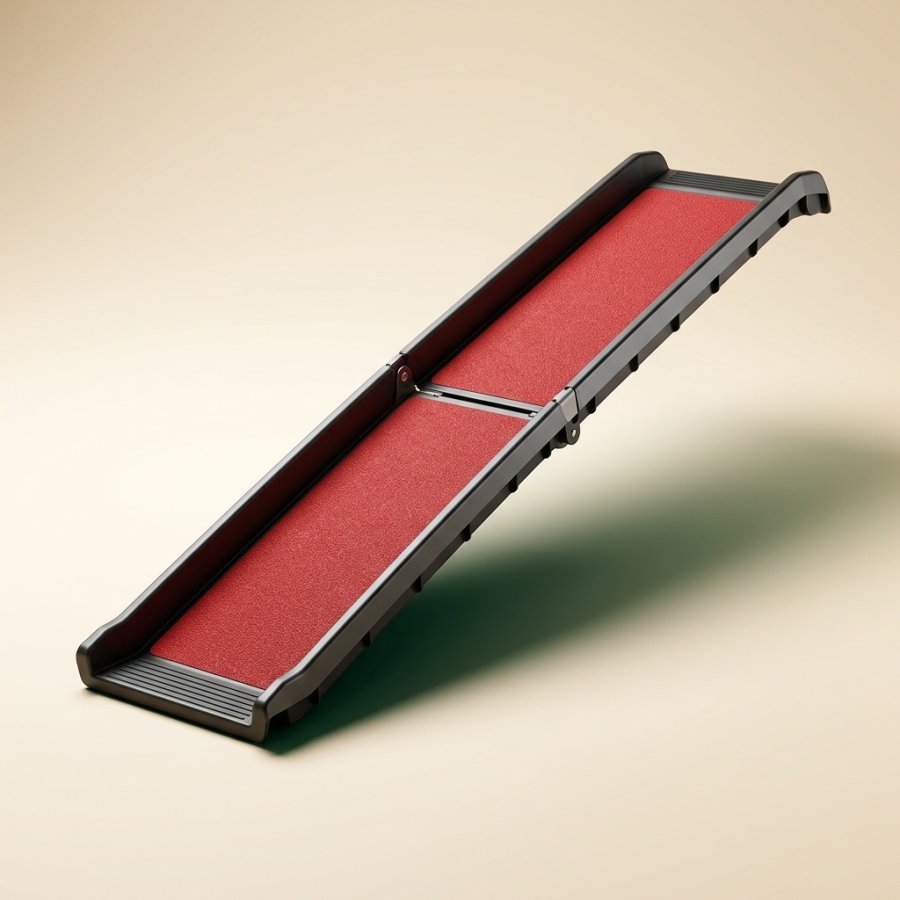 Foldable Non-Slip Dog Ramp
A folding ramp to help a dog get into the car. View
What else changes how a ramp feels underfoot?
Weight rating and width are only two checks. A longer ramp is gentler for the same boot height, so see our ramp length and angle guide and use the ramp angle calculator. A folding ramp has a join, which should lock firmly and leave no gap for a paw: see telescopic or folding dog ramp.
Grip matters too. Look for a non-slip surface and raised sides, and rest the ramp securely on the lip before every use.
Is the 90kg rating of our ramp enough for your dog?
For most dogs it will be, and for a few it will not. Our Foldable Non-Slip Dog Ramp is 155cm when open, has a non-slip surface and raised sides, and folds in half with a carrying handle. It is rated up to 90kg.
It is not the right fit if your dog is close to or above 90kg, if you need a confirmed width we have not published, or if your boot lip is high enough to make a 155cm slope steep: about 24.8 degrees at 65cm and 28.9 degrees at 75cm.
Before you buy
- Weigh your dog and compare the number with the rating, with room to spare
- Measure your dog's width and the boot opening
- Ask about any figure the page does not state
- Ask your vet before using a ramp if your dog has a mobility condition or is recovering from an operation
If your dog is a very big breed, our checklist for large and giant breeds covers head room and lifting. For lower heights, steps may suit better.
Shop the Foldable Non-Slip Dog Ramp
A folding ramp to help a dog get into the car.
View the product — £59.99Last reviewed on 9 November 2026. General information, not veterinary advice.
Related guides
Best Dog Ramp for a Car in the UK: What to Check First
Looking for the best dog ramp for a car in the UK? A buyer checklist: boot height, length, weight rating, width, grip and folded size.
Dog Ramp for a Large or Giant Breed: A Checklist
A dog ramp for a large or giant breed needs more than a high weight rating. Check weight, width, length, boot height and head room first.
Dog Ramp Length and Angle: Getting the Fit Right
How to work out the right dog ramp length for your car: measure boot height and check the angle with a simple formula.
How to Measure Your Dog for the Right Product Size
How to measure your dog for a bed, ramp or feeding stand, with step-by-step instructions and what to do between sizes.